
Blog management is new to me. I’m a copywriter, but as I sit here, I’m staring down the barrel of economic oblivion. Times are hard for writers, digital marketers, and SEO specialists right now. AI is obliterating our industry. And humanity itself is paying the price.
But enough about my mental state. You’re here to learn about blog management and content strategy. And as I’m looking for new ways to make money, I thought I’d share some of the things I’ve learned over the years.
I was a newspaper journalist once upon a long ago. I didn’t like that much, so I spent the next 15 years of my life going from one desperately unfulfilling retail or hospitality job to another.
In 2012, I decided to take a risk and start out on my own as a copywriter and blog writer. I was hopeless. I struggled like hell during those first few months. £15 here, £10 there. But with every successful blog post or copy project, I grew. I became a better writer.
Rather than invest in my own blogs – something I deeply regret today – I helped others. A lot of it was trial and error in those early days, but some of it involved trawling the internet and watching YouTube videos in a desperate attempt to learn about SEO, search marketing, and how search engines interpret blog content.
14 years later, and here I am – struggling to get up from underneath the AI behemoth that has me pinned to the floor. So, rather than wait for the bailiffs, I thought I’d share a little of my moderate wisdom on the subject of blog management and content strategy.
Now, I’m not saying I don’t use AI. I do. I used it to organise my thoughts for this very post. It advised me to write an introduction about lack of strategy, making a promise to the reader, blah, blah, whatever. I’m getting bored just writing about the experience.
Nevertheless, if you want to make sure your blog writing isn’t a giant waste of your time, I’ve got some tips and advice you might want to check out.
When you finish reading this mammoth blog post, you should have a clearer idea of what’s needed to make your blog worth the hassle. I talk about things you should avoid, things you’re probably doing but shouldn’t, and things you definitely should be doing but probably aren’t.
But mark my words; when we’re done with each other, you’ll be a blog management superstar. You’ll make every minute spent at your computer worthwhile. I’m not promising sales beyond your wildest dreams. But, at the very least, you’ll have a business or personal brand blog you can be proud of.
Let’s begin.
I Have Too Many Blog Writing Tactics and Not Enough Strategy
Here’s the problem I have. I’m here telling you how to make your business more visible to search engines. But I’m also telling you not to get lost down a Google rabbit hole looking for ways to become a better blog writer.
There are thousands of articles on blogging tactics. And the tips are too numerous to mention. Create a unique headline, link to this, link to that, use this anchor text, drop your keyword in the image file, create metadata, write this many words, and the list goes on.
Forget about all of this bullsh** for now. You could train a drunken monkey the basics of blog writing. I’m here to help you see the bigger picture. And that picture is a blogging strategy.
What the hell are we doing here? Why spend countless hours on blog management? Why put yourself through this? You need a goal. It has to be clear, and it has to be realistic.
It’s time to talk about content strategy. And while it’s not rocket science, a lot of amateur bloggers just can’t be arsed with it. Don’t be an arse when it comes to your content strategy – it’s the foundation for blogging success.
- Set a specific goal
- Define your audience
- Create a blog structure
- Devise a method of measuring results
- Roll with the punches and change course when it’s necessary
I spent years helping clients publish content without ever asking this question properly. We’d get blogs up, write decent articles, and get some rankings going. And just when I’d be basking in the warm glow of increasing organic traffic, my client would drop the bomb – and then drop me.
“Why aren’t we getting enquiries?”
SEO and blogging tactics are great for rising up the SERPs ranks, but without a clearly defined content strategy, they’re not worth sh** to your business or personal brand.
If we’re not here for conversions, then we’re not bloggers.
So before you touch a content calendar, before you pick a keyword, before you write a single word — answer these questions.
- What is this blog for?
- What does it need to achieve?
- Who needs to read it, and what do you want them to do when they’re done?
Get that nailed down, and everything else starts to make sense. Skip it, and you’re just filling the internet with more noise. And God knows there’s enough of that already.
The Ultimate Blogging Own Goal: Not Setting Your Goals from the Outset
Who doesn’t love a holiday? Back when I could afford them, my wife would plan them like a maniac. These plans would invariably involve folders, various luminous highlighters, charts, graphs, and elaborate colour-coding systems. But that’s her.
I’m different. I like to take life as it comes. Wherever I lay my hat, that’s my home. That’s just how I roll. But when it comes to blog management, that’s a disastrous approach.
If I said “right, we’re going on a road trip,” and then just started driving without telling you where we were going or how long it would take, how long before you’d question my judgment?
Yet I see businesses do this with their blogs all the time.
“We need content. Let’s just start writing about what we know.”
They proudly publish and share, and then wait for the leads to roll in. And when digital tumbleweed comes rolling into town, they either give up or scream wildly at the Google algorithm.
“Fu** it, let’s just spend a shit-ton of money on Google Ads.”
And that can work. But the best search marketing campaigns embrace the best of both worlds. Organic and paid marketing work best when they bounce off one another.
I’m not talking about something vague like “we want more traffic” or “we’d like to raise our profile.” Those aren’t goals. Those are wishes. A goal has a number attached to it, a timeframe, and a way of knowing whether you’ve hit it or not.
It’s time for a stat. More about how useful they can be for blog writers later.
The Content Marketing Institute found that among marketers who rated their content strategy as moderately effective or worse, 42% put it down to a lack of clear goals. Not bad writing or poor SEO. Not an ugly website. Just a lack of clear goals.
Nearly half of underperforming content programmes fail for the most preventable reason imaginable. Having a vision is the easiest thing in the world. Take it from me. I spend several hours a day imagining myself as a rich, gregarious novel writer with a passion for first-class travel. So why do so many business leaders and entrepreneurs go crashing into blog content writing without goals?
So, what does a proper blog goal-setting actually look like?
You might want to grow organic traffic, in which case you need a specific target and a timeframe. “Increase blog traffic by 25% over the next six months” is a goal. “Get more visitors” is a daydream.
You might want to generate leads, which means you need to know what a lead looks like, where the blog fits in the buyer journey, and what action you want someone to take when they finish reading.
You might want to build authority in your sector. That’s less about chasing search volume, more about producing the kind of content that makes potential clients think “right, these people clearly know what they’re talking about.”
Write your goal or goals down. Look at them every day. Make them a mantra for blog management success. Take them out for dinner at fancy restaurants and snog them in the back row of the cinema.
Who the Hell Are You Blog Writing For?
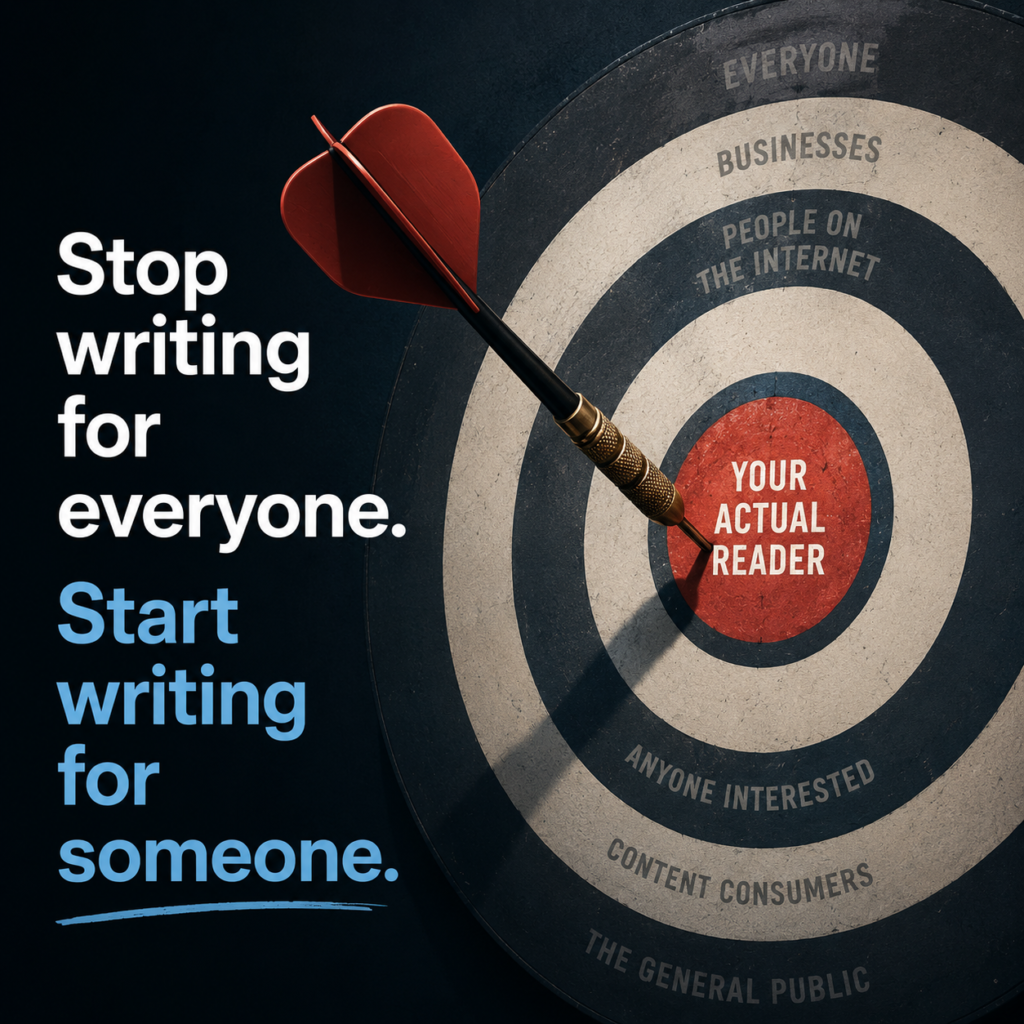
I once asked the owner of a VoIP company who he wanted me to talk to when blogging about his products and services. He said “businesses.” And that’s a common answer.
But there are around four million of them in the UK alone. I need to know exactly who I’m talking to in order to make my content resonate. To hit the spot. Great blogging is about empathy and shared pain. It’s also about sharing a vision of what’s possible. If I don’t have a Scooby Doo who I’m talking to, how can I possibly empathise?
Finding your target audience isn’t a box-ticking exercise you knock out in an afternoon and never revisit. Get it wrong – or skip it entirely – and no amount of clever SEO, snappy headlines, or well-structured pillar pages will save you. You’ll be perfectly optimised content aimed squarely at nobody.
Start with what you already know. If you’ve got existing customers, they’re your best research tool.
- What do they ask in sales calls?
- What problems brought them to you?
- What language do they use when they describe those problems?
That last one matters most — because the words your customers use are almost certainly the words they type into Google. And those are the words your blog should be built around.
If you’re starting from scratch, go looking. Forums, Reddit threads, LinkedIn comments, industry Q&A sites – wherever your potential audience gathers to ask questions and vent frustrations, that’s your research lab.
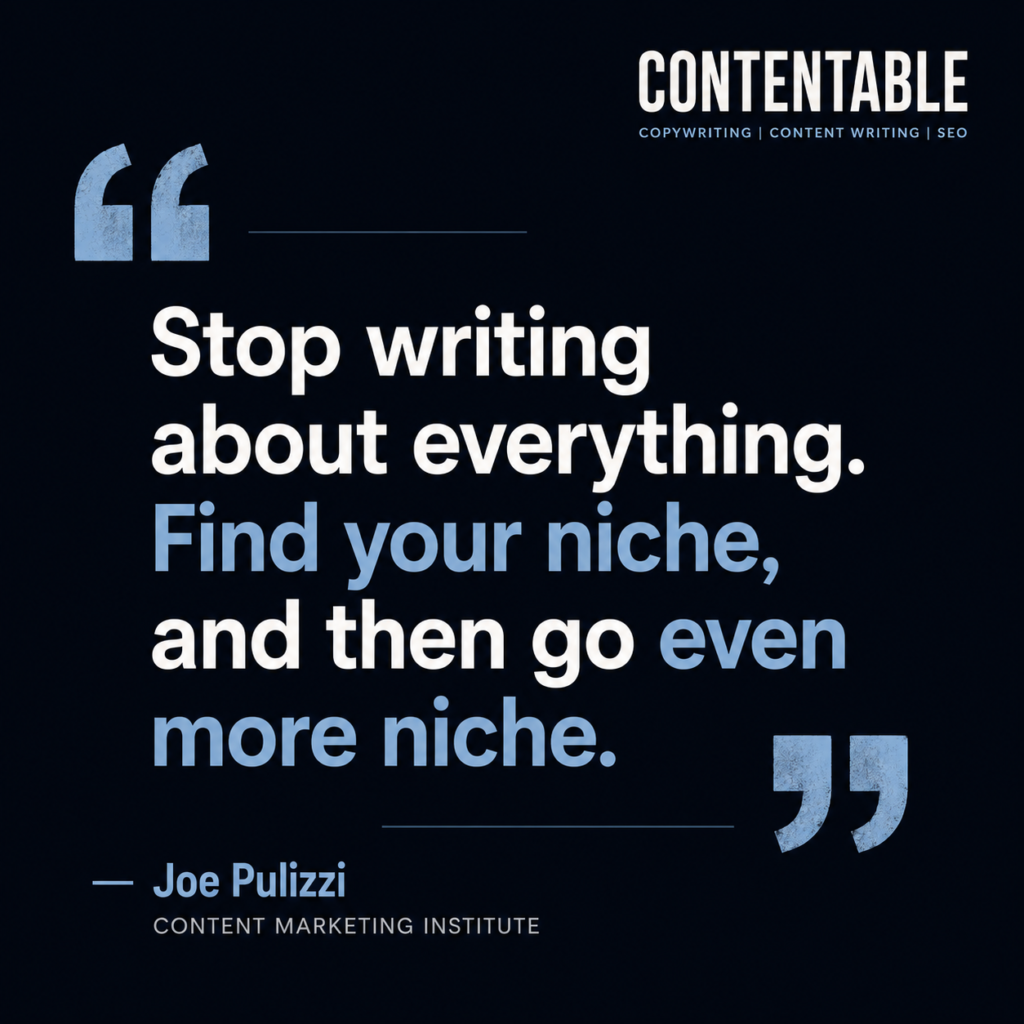
Joe Pulizzi, founder of the Content Marketing Institute, put it bluntly:
“Stop writing about everything. So many brands create content and try to cover everything instead of focusing on the core niche that they can position themselves as an expert in. Find your niche, and then go even more niche.”
He’s right. The instinct for most businesses is to cast the net wide, appeal to everyone, and keep all doors open. It feels logical. It is, in practice, a disaster. The more specific your audience, the more useful your content.
Once you’ve got a clear sense of who you’re writing blog posts for, turn that into a persona. Define their job, their biggest headaches, their goals, and their objections. Think about what would make them trust a supplier enough to get in touch. Most importantly, think about what they’re Googling at quarter to eight on a Wednesday morning when something’s gone wrong?
That question is your next blog post.
Pillars Should Be More Than Bed Cushions for Cockneys
When I lay my head on my “pillar” every night, content pillars haunt my dreams. They’re a bitch to write. They take time, planning, and a huge amount of emotional energy. But even if they take a week to write, they earn their keep a thousand times over.
Let’s take a few moments to talk about the “pillar-cluster” model.
For years, the accepted wisdom was simple enough. You wrote blog posts to get the rankings you needed to get the traffic required to get the customers who would buy your sh**. That was a mouthful, but I’m sure you see where I’m coming from.
Chuck enough content at the wall, and some of it will stick. Job done. Pint earned.
But if you’ve written blog posts in the last couple of years, you’ll know that the game has changed. Google became smart. So, instead of just looking for keyword frequency and placement, the little sh**bag now has the audacity to actually understand what’s on the page. But that’s only the start.
Google now views and appraises your entire content ecosystem. It’s trying to work out whether you actually know what you’re talking about, or whether you’re just a random collection of loosely related articles that happened to mention the right keywords.
The answer to this is something called topical authority. And the way you build it is through a pillar-cluster structure for blogs.
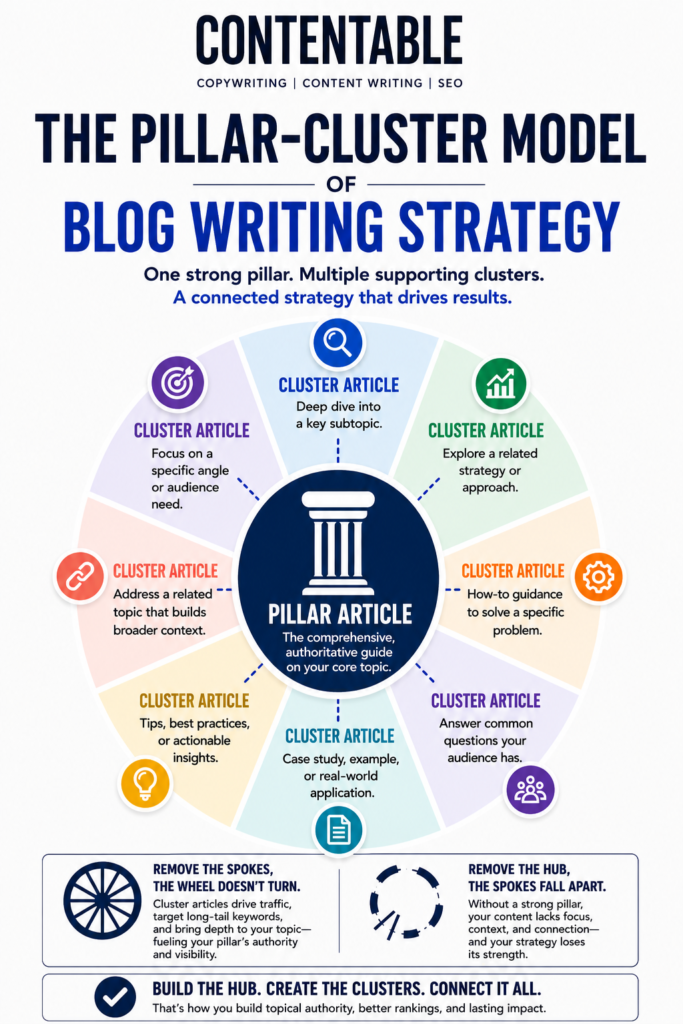
You have a pillar page – a comprehensive, long-form guide covering a broad topic in serious depth. This is the hub. Around it, you build a cluster of supporting articles, each going deep on a specific subtopic connected to the pillar.
Every cluster article links back to the pillar. The pillar links out to the clusters. The whole thing is internally connected and coherent. Do it properly, and Google says to itself, “Fu** me, this dude really does know his sh**.
Think of it like a wheel. The pillar is the hub. The cluster articles are the spokes. Remove the spokes, and the wheel doesn’t turn. Remove the hub, and the spokes fall apart.
The numbers make a fairly compelling argument. Research from Sedestral found that properly built topic clusters generate approximately 30% more organic traffic and maintain their rankings nearly 2.5 times longer than standalone posts.
How many cluster articles do you need? The benchmark is somewhere between eight and fifteen per pillar. Fewer than that, and your cluster is too thin to carry any real authority. More than fifteen and you start risking keyword cannibalisation – where your own articles compete against each other for the same searches.
Pick a broad topic your business has genuine expertise in. Build a comprehensive pillar page around it. Then work outwards, identifying the specific questions, subtopics, and related searches that sit within that subject. Each one becomes a cluster article.
Do this properly, and you stop being a website with some blog posts on it. You start being a trusted source that Google actually wants to send people to.
Building a Pillar Page for Long-Term Success
“I want it long, broad, and filled with opportunity.” Yes, many a young lady has said this to me over the years – or something to that effect. But this is something clients say to me when asking for pillar content. But size really doesn’t matter as much as people think it does!
A pillar page is not just a very long blog post. A blog post tends to be fairly narrow. It covers one topic, targets one keyword, makes one argument, and sends you on your way. A pillar page covers an entire subject area. It’s the definitive resource on a topic. It answers the big questions and points readers towards more detailed material via the cluster articles.
Think of it as the map, not the territory.
I don’t like talking about length, but let’s agree that the common consensus is 2,000 to 5,000 words. But that’s not what’s really important. The length of the pillar content reflects your depth of knowledge on the subject.
When it comes to length versus performance (sorry about the shameless double entendres), performance wins every time. A tight, well-structured 2,000-word pillar that covers a topic properly will outperform a bloated 4,500-word mess. Write until you’ve covered the subject thoroughly. Then stop.
There are three main types worth knowing about.
The Ultimate Guide covers a broad topic from end to end. You’re reading one now. The Resource Hub pulls together tools, templates, and reference material in one place. The Service or Product Pillar is conversion-focused–- it covers a subject your business operates in, while clearly positioning what you do.
Each serves a different purpose. The right one depends on your goal.
A Quick Word on Structure, Readability, and Algorithms
Use a clear H1, H2, and H3 blog heading hierarchy. Your target keyword belongs in the page title, the URL, the H1, and one H2. I also like to include the primary keyword once in the opening paragraph, near the front of the first sentence if possible.
Each major section gets its own H2. Subsections get H3s. This isn’t just good for SEO – it makes the page readable for actual humans, which remains a useful quality in a blog.
Now, a word on what happened to businesses that ignored all of this. Google’s December 2025 core update was not subtle. Sites built on thin, disconnected, or AI-mass-produced content saw traffic drops of 85 to 95%. An almost complete wipeout. Meanwhile, sites with structured topical authority held their ground or grew.
Here’s what one desperate publisher had to say about the update:
“Well… I lost over 90% of my traffic during this core update, impressions tanked, I was wiped from Discover, wiped from News and wiped from Search, clicks are abysmal and remain at their lowest since the site’s conception, all coming after years of steady growth, slashed in a matter of hours, 1,000 active users to 10, 5 of them bots from China now. Sincerely hope it returns, but wouldn’t be holding out hope. This is one tough gig, I’ll tell you that. You always know the day is coming, given everyone else’s recent experiences, but you always hold out hope you’ll survive just one more core update. Hope everyone else made it through.”
I’m not trying to frighten you. I’m trying to save you from the content equivalent of building a house on sand and then acting surprised when it slides into the sea.
Get the structure right. Build the pillar properly. Because the cluster articles that come next only do their job if the hub they’re connecting to is actually worth connecting to.
Love It Or Hate It, Blog Management Means Writing for AI Retrieval
Fu** AI. I spit in the face of LLMs. Let me preface this by saying that I’m a proud Gen Xer. I remember a simpler way of life that was ruined by the World Wide Web. So, the advent of AI is just another kick in the nuts to me. This time, however, the change is destroying more jobs than it’s creating.
That said, I use AI. And I’m never going to ignore its existence. And neither should you.
I’ve spent 14 years learning how to write content that ranks on Google. Headlines, keyword placement, meta descriptions, internal links, anchor text – the whole miserable sh** show. And just when I’d got reasonably good at it, Google decided to start answering people’s questions itself. Without sending them anywhere. Without clicking on a single blessed result.
Google’s AI Overviews – those AI-generated summary panels that now appear at the top of search results — are eating into organic traffic at a rate that should make every blogger on the planet deeply uncomfortable.
According to Pew Research Center, click-through rates drop from 15% to 8% when an AI Overview is present. That’s nearly half your potential traffic gone before anyone’s even looked at your result.
And it gets worse. A full 60% of Google searches now end without a single click. Somebody types a question, Google answers it, and the user wanders off to make a cup of tea. Your beautifully written, meticulously optimised blog post sits there, unseen, like a very well-dressed person at a party nobody came to.
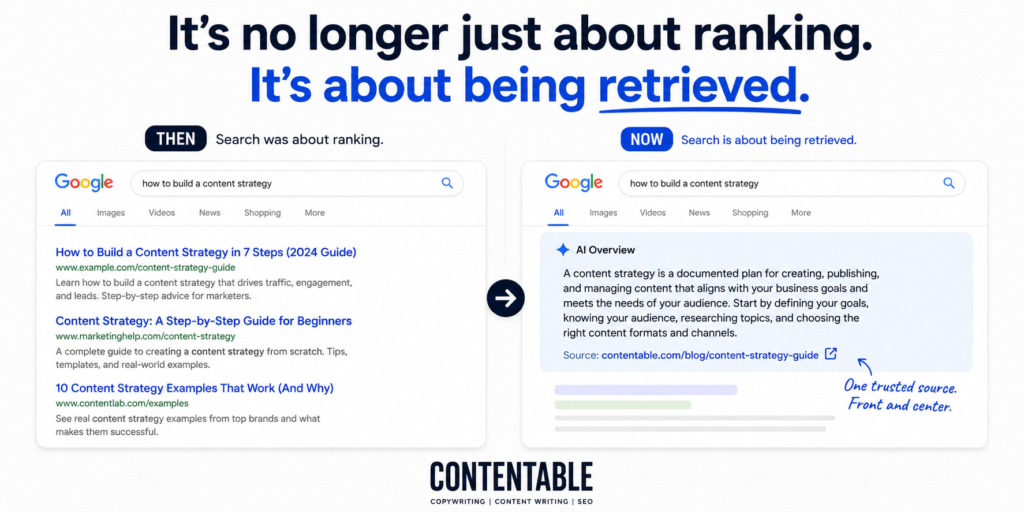
Stop writing solely for rankings. Those days are deader than a dead thing from deadland. Write for AI retrieval.
Ranking is about getting Google to list your page. Retrieval is about getting Google – or ChatGPT, or Perplexity, or whatever AI-powered search engine your audience happens to be using – to actually pull your content and cite it as the answer. That’s the new prize.
The good news is that writing for retrieval isn’t wildly different from writing good content in the first place. It just requires a bit more discipline around structure.
Here’s an approach to writing blog content for AI retrieval that has worked for me:
Answer First, Context Second, Depth Third
The inverted pyramid is your new best friend. Answer the question first. Give the context second. Provide the depth third. Each section of your blog post should be able to stand alone as a complete, self-contained answer to a specific question. If an AI can’t extract a clean, useful answer from one of your H2 sections without reading the whole piece, rewrite it until it can.
Your Subheadings Are Now Doing Heavy Lifting
Question-format headers – the kind that match how people actually type or speak a query – dramatically improve your chances of being retrieved. “What is a pillar page?” performs better as a header than “Pillar Page Overview.” It sounds like a small thing, but it isn’t.
The Fundamentals Haven’t Gone Anywhere
Here’s the counterintuitive bit. Proper structure, genuine expertise, clear writing, and strong internal linking all still matter. The sites being cited by AI engines are overwhelmingly the same sites that rank well in traditional search.
Either Adapt or Write LinkedIn Posts About How AI Destroyed Your Business
You don’t have to love this. I certainly don’t. But you do have to understand it. Because the bloggers and content strategists who adapt to this new reality are the ones who’ll still be standing when the dust settles.
The rest will be writing LinkedIn posts about how AI destroyed their business. I’m not ready to be one of those people…yet.
Keywords Shouldn’t Be the Driving Force Behind Your Blog Content Strategy
When I decided to stop being a UK copywriter, I became a content strategist. I basically do the same old sh**, but now I sound fancier. The same way a roadsweeper felt when he decided to start calling himself an on-street hygienist.
But the change in direction made me reassess the entire SEO content writing process. I did some research. I assessed the work of my peers. I cried at the realisation that the talent out there right now is better than it’s ever been – in spite of artificial intelligence.
And what I found, after all that research and reassessment, is that the entire industry has been collectively obsessed with the wrong thing for the best part of a decade.
Keywords.
Keywords still account for a meaningful chunk of any decent SEO professional’s working week, and anyone telling you they’re completely dead is trying to sell you something. But here’s the thing — a keyword tells you what someone typed, but what it doesn’t tell you is why they typed it. And that “why” is where the real content strategy lives.
That “why” is called search intent. And in 2026, it’s the most important concept in content strategy bar none.
Say you’re an accountant in Birmingham (the English one … the original one.. You could target the keyword “accountant Birmingham” and write a page optimised to within an inch of its life around that phrase.
But this is a better strategy. Ask yourself, “What does someone actually want when they type that? Are they looking for tax advice? A fixed-fee service? Someone to sort out their VAT return before HMRC knocks on the door? Each of those is a different intent. Each requires different content. Targeting the keyword without understanding the intent is like knowing someone’s address but having no idea why you’re going there.
Google’s Danny Sullivan put it plainly at WordCamp US 2025: “Good SEO is good GEO.” The fundamentals remain the same. But execution – specifically, how well your content matches what a searcher actually – matters more than ever.
Build your content strategy around topics and audience needs first, and use keyword research to ensure your content reaches the right people or businesses.
Keyword research is an input, not the engine. The engine is understanding your reader well enough to know what questions they’re asking before they’ve even typed them.
Start with your pillar topic. Build your cluster around the specific questions, problems, and decisions your audience is wrestling with. Then use a keyword tool such as Moz, Ahrefs, Google Search Console, or whatever you’ve got access to to check search volume, identify the best phrasing, and make sure you’re not writing five articles about the same thing.
And a quick but important shout-out to keyword cannibalisation before I move on. This is one of the quietest and most damaging content strategy mistakes you can make.
Each primary keyword should map to one page and one page only. If you’ve got ten blog posts all circling the same phrase, none of them will rank particularly well. You’re essentially splitting your own authority and handing the ranking to somebody else.
Use keywords intelligently. Let them inform your content, not dictate it.
Build Credibility and Authority with External and Internal Links
Simply throwing links at your blog posts is no longer good enough. In fact, it could cause more harm than good if you’re not putting sufficient thought into the process.
Yes, you’re trying to impress Google, but it’s important not to lose sight of the fact that you’re primarily talking to real people. You’re providing value. You’re giving people the insights and know-how they need to make decisions, improve their lives, or grow their businesses.
When you add a link, it should further the conversation, provide a deeper understanding, or add context to what you’re saying. If it does none of the three, you’re simply ticking an SEO box – and that could get you blacklisted if you do it too often.
Internal Links: The Roads Between Your Content
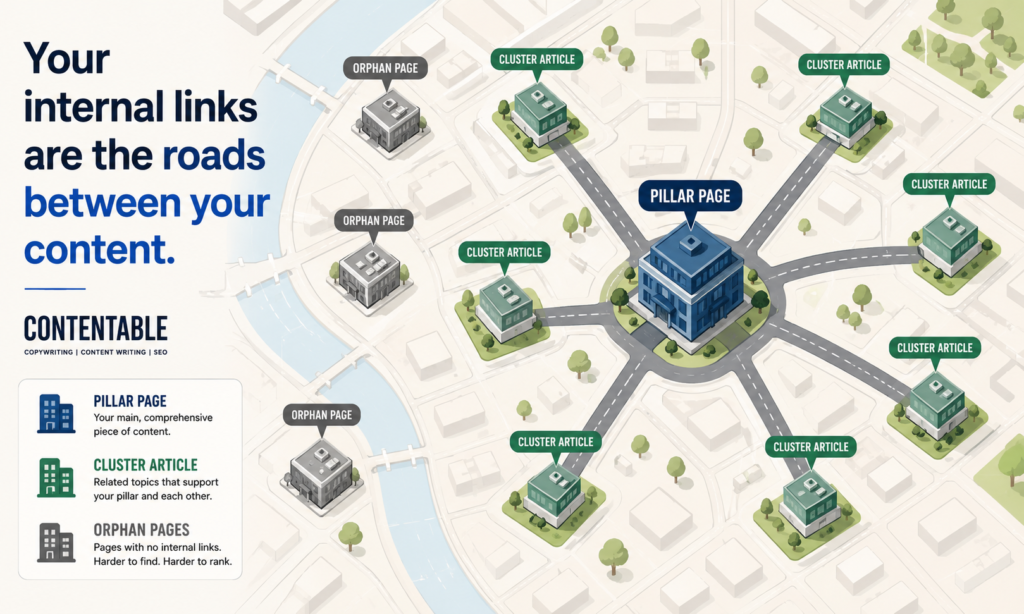
Think of your blog as a city. Each article is a building, and the Internal links are the roads connecting them. A city full of buildings with no roads between them isn’t a city – it’s a collection of structures nobody can navigate.
A well-planned internal linking structure does two things simultaneously. It tells Google which pages on your site matter most, and it guides real readers deeper into your content when they want to know more. Neither should be an afterthought.
The numbers back this up. A solid internal linking strategy can boost search rankings by up to 40% and improve organic traffic by 30% or more, simply by making sure authority flows properly between your pages.
Aim for two to five contextual links per 1,000 words, embedded naturally within your content – not shoved into a sidebar or bolted on at the bottom. Anchor text should describe the destination: “how to build a topic cluster” is useful. “Click here” is not.
And don’t leave pages as orphans. A page with no internal links pointing to it is essentially invisible. You you the building; you just forgot to build the road.
External Links: Borrowing Someone Else’s Credibility
External links make a lot of bloggers nervous. I’ve been met with this question more than a few times: Why would I send people away from my site?
Citing credible sources doesn’t weaken your content; it makes it more trustworthy. It signals to Google that you’ve done your research and you’re not just making things up and hoping nobody checks.
- Link to original research.
- Link to expert sources.
- Link to the studies you reference when you drop a stat.
If you mention data without linking to where it came from, a sharp reader will question whether it’s real.
Avoid linking indiscriminately. Don’t drop external links because you’ve heard you’re supposed to have them, with no thought given to where they’re going. A link to a low-quality or irrelevant site doesn’t add credibility. It actually does the exact opposite.
The test for any link is always the same:
- Does it further the conversation?
- Does it provide deeper understanding?
- Does it add context?
If the answer to all three is no, get rid.
Create an Editorial Calendar – and Actually Use It!
I used to be just like you. I’d eventually write a random blog post on a boring Saturday morning, publish it, and spend the next two weeks congratulating myself. After the third week, I’d start thinking about the next one. And I’d end up writing about something completely unrelated. Random. Scattergun.
The result was exactly what you’d expect: sporadic, unfocused, and largely invisible.
An editorial calendar is not a corporate affectation. It’s not something that only agencies with teams of twelve and a standing budget for collaborative planning software need to worry about. It’s the difference between a blog that actually does something and one that just exists.
The evidence is fairly damning on this front. According to Marketing Insider Group, 65% of the most successful B2B marketers have a documented content strategy – compared to just 14% of the least successful. That gap isn’t explained by talent or budget. It’s explained by planning.
At its most basic, an editorial or content calendar is a record of what you’re publishing, when you’re publishing it, and who’s responsible for making it happen. Add columns for your target keyword, which pillar or cluster it belongs to, and what the call to action is — and you’ve got something genuinely useful.
I’ve seen more editorial calendars die in a Google Sheet graveyard than I care to count. They get built in a burst of enthusiasm, populated with three weeks of content, and then quietly abandoned when something more urgent comes along.
An editorial calendar only works if you treat it as a non-negotiable part of your content operation. Schedule time each week to update it. Review it monthly. Let it drive your content decisions rather than the other way around.
Cadence matters more than volume. Publishing one well-crafted, properly structured article per week will outperform three rushed posts every time. Pick a frequency you can sustain without losing your mind, put it in the calendar, and stick to it like your rankings depend on it.
Audit What You Have Before You Decide What You Need
Here’s a thought that took me an embarrassingly long time to arrive at. Before you spend another second thinking about what to write next, it might be worth finding out whether what you’ve already written is actually doing its job.
Most businesses treat their blog like a one-way conveyor belt. Content goes on at one end, gets published, and then disappears into the void while everyone moves on to the next idea. Nobody looks back. Nobody checks. Nobody asks whether the thing they spent three hours writing eighteen months ago is still ranking, still relevant, or still making any kind of useful contribution to the world.
This is a waste of a significant asset. And in many cases, it’s actively damaging.
Content decays. Rankings that looked healthy two years ago quietly slide as competitors publish stronger material, search intent shifts, and the statistics you cited start to look like historical artefacts. A page stuck on position twelve that was once at position four isn’t broken – it’s just been neglected. And a neglected page can often be recovered far more quickly and cheaply than a new page can be built from scratch.
HubSpot found that refreshing existing blog content produced an average 106% increase in organic traffic from those pages – and more than doubled the leads they generated. Not from publishing dozens of new articles, but from fixing what was already there.
So before you commission another ten blog posts, open Google Search Console and actually look at what you’ve got. You’re looking for a few things.
- Pages with declining rankings anything that’s dropped significantly from where it was six months ago deserves investigation.
- Pages with growing impressions but flat clicks – these are appearing in search results but failing to get chosen, which usually means the title or meta description needs work.
- Pages with outdated information – old statistics, broken links, references to tools that no longer exist, or advice that’s been overtaken by events.
- Orphan pages – content that exists but has no internal links pointing to it, invisible to both Google and your readers.
For each page you find, you’ve got four options:
- Update it – bring the content current, improve the structure, add depth where it’s thin.
- Merge it – if you’ve got two articles circling the same topic, consolidate them into one stronger piece and redirect the old URL.
- Leave it alone – if it’s performing well, don’t touch it out of habit.
- Kill it – if a page has no traffic, no rankings, no backlinks, and no realistic future, removing it and redirecting the URL is often the cleanest solution.
A bad web page can stick the place out. And no amount of SEO air freshener will be able to remove the stench from the rest of your site.
Never Throw in the Towel, But Know When It’s Time to Change Course
I can honestly say that this is the biggest issue I come across when meeting clients about potential blog management projects. They simply lose interest. A few dud posts dying a slow death on page 45 of SERPs can spell the end of a blogging career. But it’s important to keep your eye on the prize.
You’re the best person to blog about what you do or sell. You’ll always be infinitely better at it than me. But I’m a great writer, I know why SEO sh**, and I do this for a living. You, on the other hand, have bigger fish to fry. You may simply not have the time. Or you may prefer to have your privates wired to the mains than write two or three blog posts every week for several years.
To be honest, in the age of AI, this is the only reason I have the merest hint of a copywriting and content writing career. I stick at it. I enjoy writing. So, when you’re ready to give up, approach someone like me. Someone who’ll stay the course.
Nobody likes admitting their content is getting old. It feels a bit like looking in the mirror on a Monday morning. You know what you’re going to see. You’d just rather not.
But content decay is real, it’s relentless, and ignoring it is one of the most expensive mistakes a blogger can make. Rankings don’t collapse overnight. They slip gradually. And by the time you notice the traffic’s gone, you’re already three months behind where you needed to be.
HubSpot found that 76% of monthly blog views and 92% of blog-generated leads came from existing posts – not new ones. And when they optimised older content, they saw an average 106% increase in organic traffic.
Let that sink in. More than double the traffic. Not from writing fifty new articles. From fixing what was already there.
Don’t give up, just change direction. Monitor your posts; treat every one of them as if it were a standalone website.
How Often Should You Update Blog Posts?
It depends on how fast your industry moves, but here’s a sensible baseline. Evergreen content — the stuff that doesn’t change much – needs reviewing every six to twelve months.
Competitive topics where rivals are constantly publishing should be looked at every three to six months. If you’re in a fast-moving sector like tech, AI, or finance, some content needs attention every one to three months. And if you’re publishing anything time-sensitive, treat it as a living document.
The mistake most people make is setting a calendar reminder and refreshing content regardless of whether it needs it. Update based on signals, not habit.
The Signals That Tell You It’s Time to Change Your Blog Writing Approach
Open Google Search Console. You’re looking for four things:
Rankings dropping: Any page that’s slid significantly from where it was six months ago deserves investigation. Something has changed – either your competitors have improved, search intent has shifted, or your content has simply aged past its usefulness.
Impressions growing, clicks not so much: The page is appearing in search results but people aren’t choosing it. That usually means your title tag or meta description needs rewriting. You’re showing up to the party but nobody’s interested in talking to you.
Outdated information: A stat from 2021 cited in a 2023 article sitting on your page in 2026 is a credibility problem. Readers notice. More importantly, AI systems notice – and they’re increasingly bypassing stale content in favour of fresher sources.
A stat from 2021 cited in a 2023 article sitting on your page in 2026 is a credibility problem. Readers notice. More importantly, AI systems notice – and they’re increasingly bypassing stale content in favour of fresher sources. Ahrefs found that AI-cited content is 25.7% fresher on average than traditionally ranked content.
Broken links: A page full of links that go nowhere tells Google your content isn’t being maintained. It also tells your readers you’ve stopped caring. Both are bad.
Or Just Give All Blog Management Responsibilities to a Seasoned Content Strategist
I’m fu**ing exhausted now. This has taken me eight hours – with breaks for Only Fools and Horses. But I’m done. I’ve given you an in-depth guide that should help you become the blog manager and content strategist you were born to be.
Can’t be chewed? I feel your pain. Believe it or not, I prefer writing blog content for my clients. Writing for my own website is just so dull. After all, I DO blogging every day.
So, if you want to give a handsome, experienced, and passionate blog content writer the responsibility of growing your online presence, you know what to do. Give me a tinkle on +44 07386 704 956 or drop me a line at malcolm.cox@contentable.biz. There’s also a contact from you can fill in.
That’s it. Time for whisky.


