
You’ve heard the term. You’ve probably nodded along in a meeting when someone mentioned it. But if someone put a gun to your head and asked you to explain exactly what a pillar blog post is and why it matters, would you survive the encounter? If my experiences are anything to go by, most people wouldn’t.
This is the next instalment of our ongoing blog management guide. Happy reading. Hopefully, you’ll learn something. Alternatively, you’ll know what you don’t know and come to someone like me, your faithful copywriter and content writer in Newcastle Upon Tyne.
What Is a Pillar Blog Post?
A pillar blog post is a comprehensive, long-form piece of content that covers a broad topic in serious depth. It’s the SEO mothership in a niche galaxy far, far away. The one piece of content that everything else on that subject connects to.
But length without structure is just noise. And yes, that’s what she said. A genuine pillar blog post covers an entire subject area and points readers towards more detailed material through a network of supporting cluster articles.
Think of it as the map, not the territory. The map tells you what’s there and where to go. The territory is what your content strategy fills in around it.
There are three main types worth knowing about:
The Ultimate Guide: Covers a broad topic from end to end. The one you’re reading right now is a cluster article supporting one.
The Resource Hub: Pulls together tools, templates, and reference material in one place.
The Service or Product Pillar: Conversion-focused content that covers a subject your business operates in while clearly positioning what you do and why you do it better.ƒ
Each serves a different purpose. The right one depends on what you’re trying to achieve.
What Is Pillar Content and Why Does Google Care?
Google needs to know that you have your sh*t together and that you’re not some fly-by-night merchant who just recycles content for clicks.
For years, the accepted content marketing wisdom was simple enough. Write blog posts, target keywords, get rankings, get traffic, get customers. Chuck enough content at the wall, and see if some of it sticks.
Then Google got smart. Rather than just looking for keyword frequency and placement, it started evaluating your entire content ecosystem, working out whether you actually know what you’re talking about, or whether you’re just a loose collection of vaguely related articles that happened to mention the right words.
And then LLMs came along. All of a sudden, Google and other search engines could understand what’s on the page and how valuable it is to readers compared to similar indexed content.
According to Search Engine Land’s analysis of Google’s core update behaviour, each major update moves Google’s ranking systems further towards evaluating semantic context and topical authority, rather than relying on traditional keyword matching alone.
Sites that lost rankings weren’t necessarily publishing bad content. They lacked clear topical structure and comprehensive coverage. The answer to that problem is topical authority — and the way you build it is through a pillar-cluster structure, which is where your blogging strategy either starts earning its keep or quietly falls apart.
What Is the Pillar-Cluster Strategy?
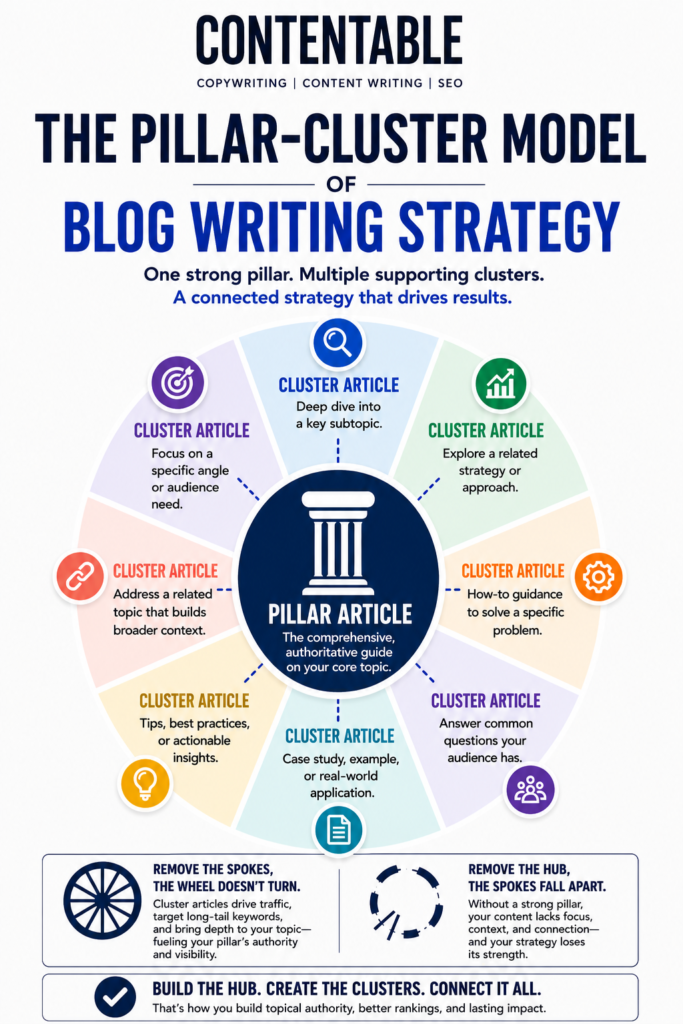
The pillar-cluster strategy is a content architecture model built around one central hub — the pillar — and a network of supporting cluster blog posts that connect back to it.
You have a pillar page covering a broad topic in depth. Around it, you build a cluster of supporting articles, each going deep on a specific subtopic. Every cluster article links back to the pillar. The pillar links out to the clusters. The whole ecosystem is internally connected, coherent, and signals to Google that you genuinely own the subject.
Think of it as a wheel. The pillar is the hub. The cluster articles are the spokes. Remove the spokes, and the wheel doesn’t turn. Remove the hub, and the spokes fall apart. Good blog writing at the cluster level only works if the hub it connects to is actually worth connecting to.
The numbers make a compelling argument. According to HireGrowth’s 2025 analysis cited by Search Engine Land, content grouped into topic clusters drives approximately 30% more organic traffic and holds rankings 2.5 times longer than standalone posts. That’s not a marginal improvement. That’s a structural advantage that compounds over time.
How many cluster articles do you need? The benchmark is eight to fifteen per pillar. Fewer than that and your cluster is too thin to carry meaningful authority. More than fifteen and you risk keyword cannibalisation, where your own articles compete against each other for the same searches, which helps no one and irritates everyone.
Pillar Content Strategy Examples in Practice
If you’re managing our own business blog, you’ll need to start by finding your blogging niche. Once you find your niche, identifying your target audience should be child’s play. I’ve developed a few business blogging strategies over the years, and during that time, I’ve developed a tried-and-tested process.
Here’s what a pillar content strategy looks like when it’s actually working:
A B2B software company selling project management tools might build a pillar page around “project management for remote teams.” The cluster articles sitting around it cover specific subtopics: asynchronous communication, remote team accountability, software comparisons, and how to run effective virtual stand-ups. Each goes deep on its subtopic. Each links back to the pillar. Together, they tell Google that this company understands the subject at every level.
A professional services firm might build a pillar around “financial planning for small business owners,” with cluster articles covering cash flow management, tax planning timelines, business insurance basics, and pension options for sole traders. Same architecture, completely different sector.
The subject changes. The structure doesn’t. That consistency is what makes blog goal setting so important because you need to know what you’re trying to achieve before you decide what to build.
How to Build a Pillar Blog Post That Actually Works
Structure matters more than length, though length matters too. The common consensus is 2,000 to 5,000 words, but a tight, well-structured 2,000-word pillar that covers a topic properly will outperform a bloated 4,500-word mess every time.
Write until you’ve covered the subject thoroughly, then stop. You don’t want to bore the reader. That might work well with Google, but it won’t with real-life human beings!
On structure: use a clear H1, H2, and H3 hierarchy. Your primary keyword belongs in the page title, the URL, the H1, and at least one H2. Include it once in the opening paragraph, near the front if possible. Each major section gets its own H2. Subsections get H3s. This isn’t just good for SEO — it makes the page readable for actual humans, which remains a useful quality in a blog.
On what happens when you ignore all of this: ALM Corp’s analysis of the December 2025 Google core update found that thin affiliate content lacking original analysis saw 71% traffic drops, while mass-produced AI content without expert oversight reported an 87% negative impact.
Sites with deep content clusters of ten to fifteen high-quality supporting articles, meanwhile, saw an average 23% gain in visibility. The content writing services that delivered results through that update were the ones building proper architecture, not just publishing volume.
Start With the Pillar. Build Everything Else Around It.
A cluster blog post only does its job if the hub it connects to is worth connecting to. Get the pillar right first. Then build outward, systematically, with a clear sense of which subtopics your audience actually needs answered.
Do it properly, and you stop being a website with some blog posts on it. You start being a trusted source that Google actually wants to send people to and that your target audience actually wants to read.
If you want that to happen without the considerable time and emotional energy it takes to do it yourself, our bottomless copywriting subscription covers pillar pages, cluster articles, and everything in between. Contact me today to arrange a video consultation or call me on 44 7386 704956.


